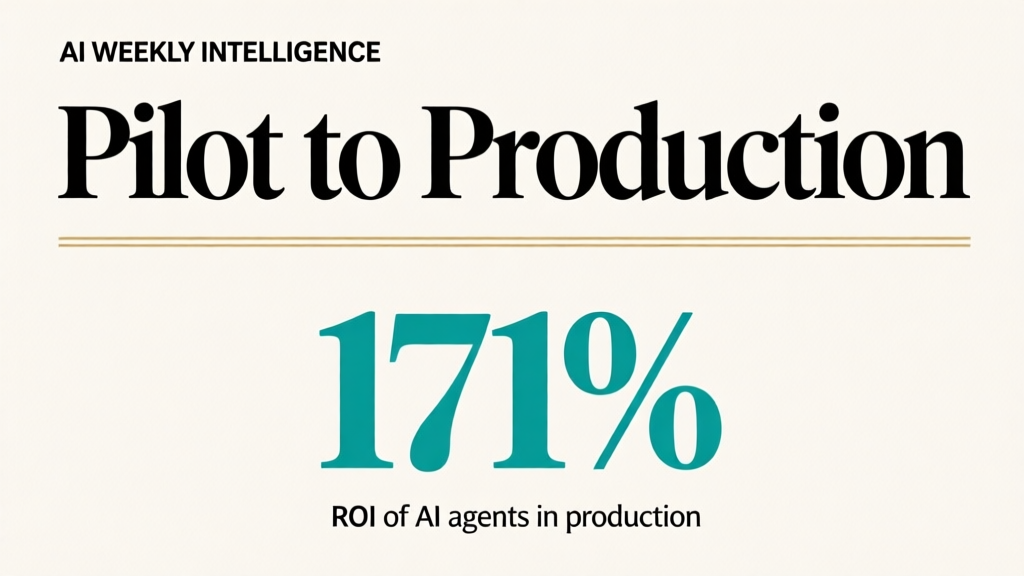
Pilot to Production: why AI pilots stall — and what the ones that succeed return
Two numbers tell the whole story of AI in 2026. One: AI agents that actually reach production deliver 171% ROI. Two: most AI pilots never get there. The gap between those numbers is where budgets quietly disappear — and where managed AI was built to close the gap.
The number that changes the conversation
When analysts at IDC teamed up with Microsoft to study what AI agents actually deliver inside organisations, one figure cut through everything else: organisations running AI agents in production report 171% ROI globally — and 192% in the US (secondary-sourced via trade press, week ending 7 September 2026).
Read that number again, because it is not a forecast and not a projection. It is a measurement of what happens after the hard part is done. The hard part is not the technology. It is the two metres between the pilot and the production system — and that is where most AI initiatives quietly die.
The corollary is uncomfortable but useful: the question “is AI worth it?” has already been answered. Production AI returns 171%. The live question is narrower and much more useful: what separates the pilots that reach production from the ones that don’t?
Pilot purgatory: the pattern behind the wasted spend
Ask around any mid-sized company that has “done something with AI” and you’ll hear the same biography. A tool was trialled — a chatbot, a content generator, an analytics assistant. It impressed people in a demo. Someone wrote a summary document. Six months later the licence has quietly lapsed and the process is exactly as it was before.
This is pilot purgatory: AI deployed without operating discipline. The pilot runs on enthusiasm. Production runs on a system. And enthusiasm, as every business owner over 40 knows, is not an operating model.
The pattern is now recognised well beyond our own observation. “The AI maintenance problem” has emerged as a named category in trade analysis (ET CIO SEA, week ending 7 September 2026) — a recognition that the bottleneck has moved from deploying AI to operating AI. The 2026 story is no longer “can we get AI?” It is “who keeps it running?”
Why pilots stall — the five failure points
- No owner. The pilot was “someone’s side project.” When that person’s week fills up, the pilot stops. Production AI needs an accountable owner — a person or a team — with time actually reserved for it.
- No cadence. Pilots run when someone remembers. Production runs on a fixed rhythm: weekly output, weekly review, monthly measurement. Without a cadence, quality drifts and results can’t compound.
- No quality bar. In a pilot, “pretty good” is enough. In production, output represents your brand to your customers every week. Without review standards — and a human review layer — quality becomes the reason leadership quietly pulls the plug.
- No governance. Who may the AI talk to? What data can it see? What happens when it makes a mistake? Pilots defer these questions; production cannot. Governance is not bureaucracy — it is what makes the system safe to leave running.
- No measurement. A pilot is judged on impressions. Production AI is judged on leads, deals, costs, and hours returned. If nobody is counting, the project becomes the first line item cut in the next budget review.
None of these are technology problems. All five are operating problems. That is why buying a better tool has never fixed a stalled pilot — and never will.
What production actually returns
When those five gaps are closed, the returns stop being hypothetical. The 171% figure is the headline, but the underlying pattern is what matters for an SME deciding how to spend:
- Compounding, not one-off. A production system gets better every week it runs — content compounds, data accumulates, processes shorten. A pilot resets to zero every time someone restarts it.
- Capacity, not headcount. Production AI returns hours. The marketing output of a small team, the analysis speed of an analyst, the consistency of a machine that doesn’t have busy weeks.
- Measurability. Because production runs on cadence and review, its results are countable: output per week, response times, conversion from AI-assisted channels. What gets measured keeps its budget.
For a Swiss SME, the numbers land close to home. Swiss SME AI adoption sits around 34% — but only about 8% run AI in systematic production (AXA/Sotomo 2025; FSO 2024). That 26-point gap is the Swiss version of pilot purgatory: a third of the market has adopted AI, almost nobody has finished. The ROI rewards the ones who close the last two metres.
The operating model that closes the gap
Every stalled pilot has a missing operating layer: strategy, cadence, review, governance, measurement. That layer is a discipline, and discipline is a staffing question — which is precisely where SMEs get stuck, because hiring a full team to babysit a pilot makes no economic sense.
This is the structural argument for a managed AI service, and it deserves to be stated plainly:
- A strategy before the technology. What should AI do for this specific business? Where does it pay back first? A pilot without a strategy is a toy.
- A fixed cadence, run by someone whose job it is. Weekly output, weekly review, monthly reporting — not when someone finds time.
- A human review layer. Every deliverable checked before it reaches your customers. AI drafts; a professional signs off.
- Governance from day one. Scoped permissions, audit trails, compliance handled as standard — including the EU AI Act transparency layer that applies to AI-generated content.
- Measurement in business numbers. Leads, revenue, hours saved, cost avoided — reported every week, in language a board understands.
The decision, then, is not “tool vs. no tool.” It is: who operates it? Do-it-yourself means hiring the operating layer you don’t have. Managed means the operating layer arrives built-in — and the pilot-to-production gap is someone else’s job description, not your next internal project. We looked at the same operating question for marketing teams earlier this year.
The board-case number, for the people who need one
If you are the one building the internal case (and you know who you are), here is the version that fits on one slide:
Independent research (IDC × Microsoft, 2026) finds organisations running AI agents in production report 171% ROI globally — 192% in the US. The majority of pilots never reach production, not because the technology fails, but because nobody owns the operating layer: strategy, cadence, review, governance, measurement. Managed AI closes that gap without hiring the team.
That is the whole case. The technology is proven; the failure mode is known; the fix is organisational. What remains is a decision about who operates.
From here
Thirty minutes is enough to see where your pilot — or your stalled “AI project” — sits on the five failure points, and what it would take to move it into the 171% group.
Contact us for a free 30-minute readiness check.
Sources
- IDC × Microsoft research on AI agents in production — 171% ROI global / 192% US (secondary-sourced via trade press, w/e 7 Sep 2026).
- ET CIO SEA, w/e 7 Sep 2026 — “AI maintenance problem” emerging as a named category.
- AXA/Sotomo 2025 and Swiss Federal Statistical Office 2024 — Swiss SME AI adoption (~34%) vs. systematic production use (~8%).
- OECD D4SME Survey 2026 — 76% of SMEs remain AI novices; only 3.6% structured production use.
Ai-Fi — AI business solutions for Swiss and Italian SMEs. Consulting, implementation, and managed AI products. Content drafted for the Weekly Intelligence programme; figures cited as published, no client outcomes implied.